Blockchain Scalability Solutions: Layer 2 and Sharding Explained
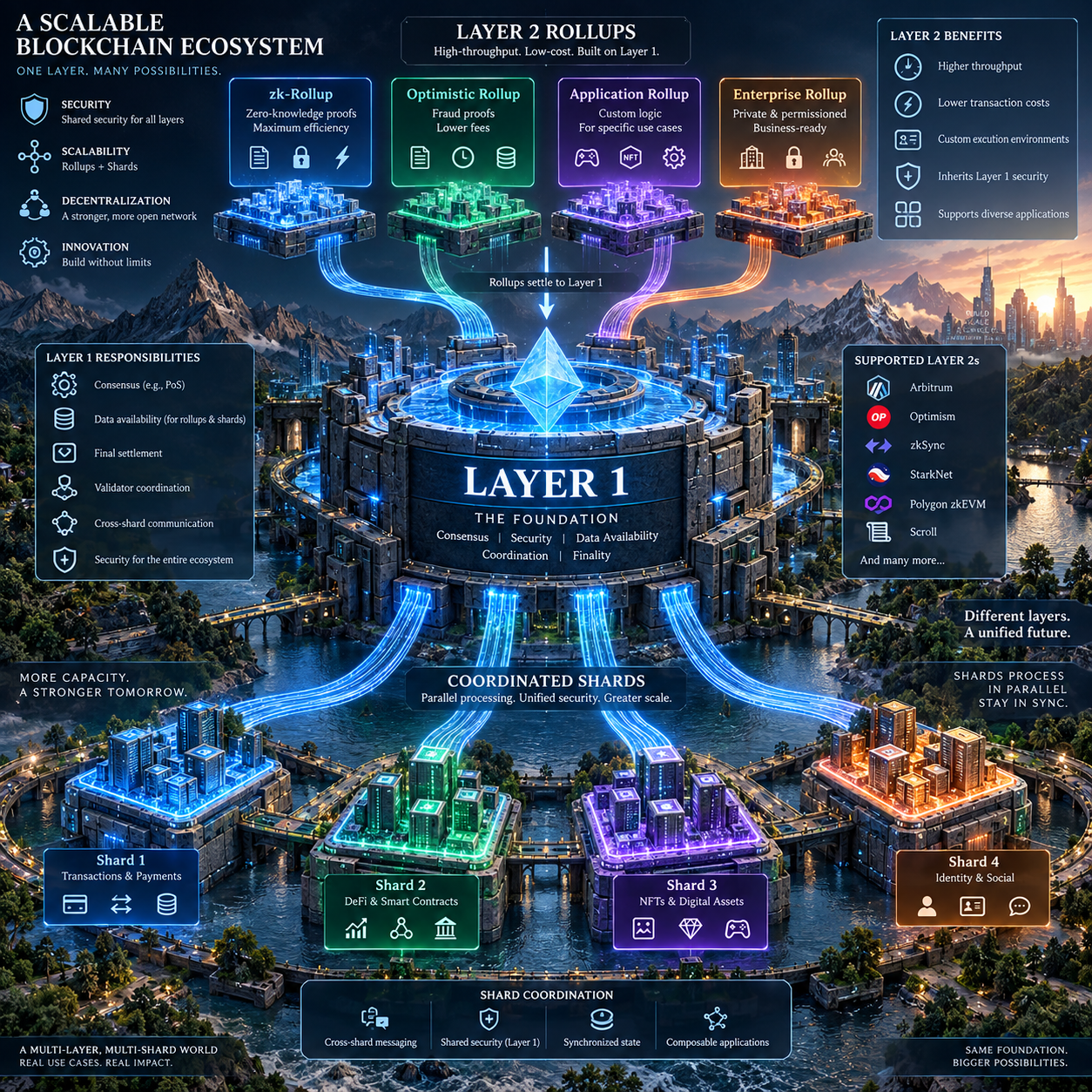
Blockchain scalability is the ability of a network to handle more activity without making transactions too slow or expensive. Layer 2 solutions and sharding both aim to increase capacity, but they do so in different ways: Layer 2 processes activity outside the base chain, while sharding divides work within a network.
Neither approach removes every constraint. The design must also preserve security, keep data available for verification, and avoid making participation so demanding that fewer people can operate the network.
Why blockchains need to scale
Blockchains need to scale because a single Layer 1 can have limited capacity for processing and confirming transactions. When demand approaches that limit, users may face delays and higher network fees.
On a typical blockchain, many independent nodes verify the same transactions and agree on the state of a shared ledger. This replication supports security and decentralization, but it can restrict transaction throughput: the number of transactions a network processes over time. A larger block or shorter interval may increase capacity, yet also raise hardware and bandwidth requirements for node operators.
When users compete for limited block space, they may offer higher fees to get transactions included sooner. That can make routine actions, such as transferring tokens or using a decentralized application, costly during busy periods. The challenge is to expand capacity without weakening the network’s ability to verify activity independently.
It helps to assess scalability through three questions: How much activity can the system handle? Who can check that activity? And what happens when participants disagree or data is unavailable? A solution that improves throughput but makes verification difficult has shifted the problem rather than solved it.
What Layer 2 solutions do
A Layer 2 is a system built above a blockchain’s Layer 1 that handles some transactions separately and uses the base layer for settlement, security, or both. This can increase capacity without requiring every transaction to be processed individually by Layer 1.
Layer 2 systems often bundle many transactions, then send a summary or proof to the base chain. Users may interact with the Layer 2 for faster or cheaper activity, while the underlying Layer 1 remains an important reference point for finalizing outcomes or resolving disputes. The precise security relationship varies by design.
Rollups are a widely discussed type of Layer 2. They execute transactions outside Layer 1 and post transaction data, compressed data, or proofs to the base chain. Other Layer 2 designs may rely on different mechanisms, so the label alone does not tell users how withdrawals, failures, or disputes work.
The main trade-off is dependence on additional software and infrastructure. A Layer 2 may reduce fees for many transactions, but users still need to consider bridge risks, operator arrangements, withdrawal delays, and where the data needed to verify activity is stored.
How rollups improve scalability
Rollups improve scalability by processing transactions off Layer 1 and submitting grouped results or evidence to it. Optimistic and zero-knowledge rollups differ mainly in how they establish that the submitted results are valid.
Optimistic rollups
An optimistic rollup generally assumes a submitted batch is valid unless someone challenges it during a set dispute period. A fraud-proof process can allow an incorrect result to be contested and corrected, provided the system’s challenge mechanism and data are available.
This approach can be conceptually straightforward, but withdrawals back to Layer 1 may involve a waiting period while challenges remain possible. Some systems offer faster exits through liquidity providers, which can add fees and introduce reliance on those providers.
Zero-knowledge rollups
A zero-knowledge rollup uses a cryptographic validity proof to show that a batch follows the system’s rules. Layer 1 can verify the proof instead of re-executing every transaction in the batch.
Validity proofs can support efficient verification, but generating them and building the system can be technically demanding. Designs also differ in proof systems, supported applications, and data-availability arrangements. “Zero-knowledge” does not automatically mean private: many rollups use these proofs for correctness while transaction details remain public.
For either type, data availability matters. If users cannot access the information needed to reconstruct or verify the rollup’s state, they may be unable to act independently, even when a summary or proof appears on Layer 1. Compare a rollup’s verification, upgrade, and exit mechanisms rather than judging it by transaction fees alone.
How sharding works
Sharding scales a blockchain by dividing its data or processing work among multiple partitions called shards. Instead of having every part of the network handle every task, shards can process different activity in parallel, depending on the design.
A shard may maintain its own portion of state or handle a share of transactions. To make the overall blockchain coherent, the protocol must coordinate how shards communicate, how their results are finalized, and how validators are assigned. Cross-shard transactions can be more complex than transactions that stay within one shard because they involve coordination across partitions.
Sharding can increase capacity, but it creates new security and data-availability questions. The network needs a reliable way to ensure that shard data can be retrieved and that a shard’s validators cannot easily collude or be overwhelmed. Validator assignment, consensus rules, and communication between shards all affect the security model.
There is no single sharding design. Some approaches divide execution; others focus on distributing data so that Layer 2 systems can publish more information. As a result, claims about sharding’s effect on fees or throughput depend on what the protocol shards and how its components coordinate.
Layer 2 vs. sharding
The main difference is where the scaling work happens: Layer 2 adds a separate execution system above Layer 1, while sharding divides work across parts of the blockchain itself. Both can increase capacity, but each introduces distinct coordination and security considerations.
- Where it operates: Layer 2 processes transactions outside the base chain; sharding changes how the network distributes work or data.
- How it connects to Layer 1: Rollups typically settle results or publish data to Layer 1. Shards coordinate as parts of a broader protocol.
- What users assess: Layer 2 users should examine proofs, data availability, bridges, and exit routes. Sharding users and developers should consider shard coordination, validator security, and cross-shard activity.
- Potential cost: Layer 2 can add operational complexity and fragmented liquidity. Sharding can make protocol design and cross-partition communication more complex.
Neither approach guarantees low fees in every situation. A Layer 2 can become congested or depend on costly Layer 1 data publication; a sharded network can still face demand spikes within a particular shard. Throughput improvements are useful only when users can verify outcomes and move assets safely.
Can Layer 2 and sharding work together?
Yes, Layer 2 and sharding can work together when the base blockchain distributes data or processing while Layer 2 systems execute transactions and settle batches. Their combined design may address different bottlenecks, but the benefits depend on implementation.
For example, a rollup may process transactions away from Layer 1 and publish compressed data to a base chain that distributes data capacity across shards. In that arrangement, the rollup handles execution scaling while sharding helps the Layer 1 accommodate more rollup data. The exact relationship varies by protocol; it should not be assumed that every sharded chain supports every rollup design.
Combining methods can also make the system harder to understand. Developers must account for settlement, data availability, shard communication, and user exits. Users may need to track which network holds their assets and which bridge or wallet supports a particular route. More layers can improve flexibility, but also create more points where software, governance, or infrastructure choices matter.
Choosing a scalability approach
Choose a scalability approach by comparing security assumptions, costs, data availability, and operational complexity for the activities you need. There is no universal winner: a design that suits frequent low-value transactions may not suit an application that prioritizes simple exits or minimal trust assumptions.
For users, check which network processes the transaction, how fees are calculated, and what steps are required to withdraw to Layer 1. Confirm that the wallet and application support the network, and understand whether an exit depends on a waiting period, a proof, or a third-party service.
For developers, test the full user journey rather than focusing only on theoretical throughput. Consider contract compatibility, cross-chain liquidity, transaction data costs, monitoring, and recovery if a sequencer or other operator becomes unavailable. Security audits are useful, but they do not replace understanding the protocol’s upgrade and governance powers.
A practical decision filter is: first identify the bottleneck, then check how the proposed design addresses it, and finally map who can verify data and recover funds if something goes wrong. That last step often reveals trade-offs that headline transaction counts and fee estimates miss.
Frequently asked questions
Is Layer 2 the same as sharding? No. Layer 2 processes activity outside the base chain and connects back to it; sharding divides work or data across parts of a blockchain protocol.
Do rollups make a blockchain more secure? Rollups can inherit important security properties from Layer 1, but the degree depends on their proofs, data availability, upgrade controls, and exit mechanisms. They do not automatically make the entire system more secure.
Can sharding reduce transaction fees? It can increase capacity and may reduce congestion-related costs, but fees depend on demand, protocol design, and the specific resource being sharded. Lower fees are not guaranteed in every situation.
Can a blockchain use Layer 2 and sharding together? Yes. A blockchain can use sharding to distribute base-layer work or data and Layer 2 systems to process transactions, provided the designs coordinate securely.