Blockchain Consensus Mechanisms: Proof of Work vs. Proof of Stake

Blockchain consensus mechanisms determine how a decentralized network agrees on which transactions are valid and which block belongs next in the chain. The two best-known approaches are Proof of Work (PoW), which uses computational competition, and Proof of Stake (PoS), which uses cryptocurrency staking and economic penalties.
Neither model is automatically superior. Each makes different choices about network security, energy consumption, decentralization, participation, scalability, and attack resistance.
What Is Blockchain Consensus?
Blockchain consensus is the process that lets independent computers agree on one transaction history without relying on a central authority. It prevents conflicting records, double spending, and unauthorized changes to the ledger.
In a traditional payment system, a bank confirms whether a transaction is legitimate. A public blockchain distributes that responsibility across many computers, often called nodes. Those nodes must determine which transactions follow the rules and which proposed block should be added next.
Consensus is different from hashing or encryption. Hashing helps identify data and detect changes, while encryption protects information in certain applications. Consensus coordinates participants and defines what happens when several parties propose competing versions of the blockchain.
A practical consensus system needs to answer three questions:
- Who may propose the next block?
- How do other participants verify that block?
- What discourages dishonest behavior or an attempt to rewrite history?
PoW answers these questions through computational work. PoS answers them through capital locked in the network. Both also use incentives, rules, and penalties to make honest participation more attractive than attacking the chain.
How Proof of Work Works
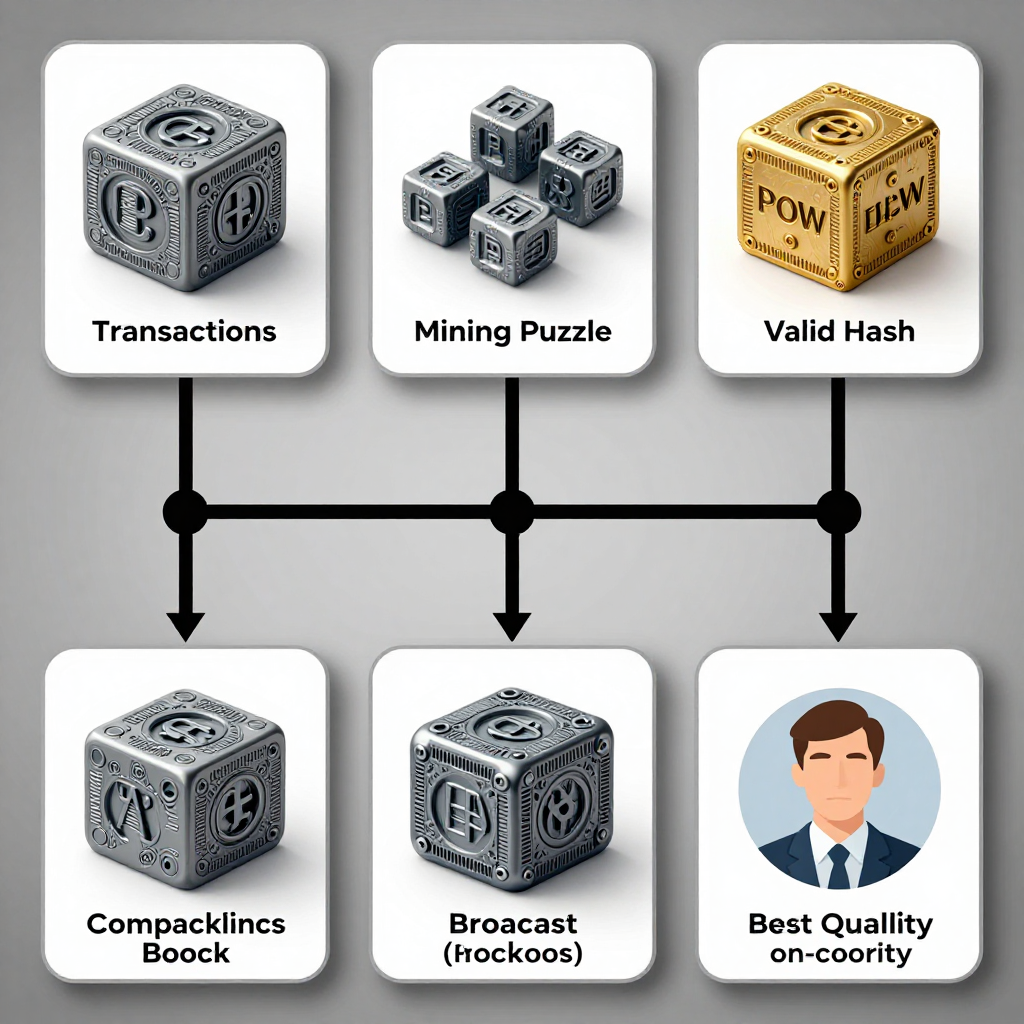
Proof of Work reaches consensus by requiring miners to solve a computational puzzle before proposing a block. The winning miner broadcasts the block, and other nodes verify the work and the transactions it contains.
The process usually follows these steps:
- Users broadcast signed transactions to the network.
- Miners collect valid transactions into a candidate block.
- Mining hardware repeatedly changes a value called a nonce and hashes the block data.
- The miner searches for a hash that meets the network’s target.
- The successful miner broadcasts the block and proof of the completed work.
- Other nodes check the transactions, block structure, and proof before accepting it.
The puzzle is difficult to solve but easy for everyone else to verify. This asymmetry is central to PoW. Miners spend electricity and hardware capacity to compete, while verification requires comparatively little computation.
Mining difficulty adjusts as the network’s total computing power changes. A higher difficulty makes it harder to find a valid block, helping maintain a relatively predictable block schedule. On networks such as Bitcoin, miners may receive block rewards and transaction fees for producing an accepted block.
PoW’s security comes from the cost of rewriting history. An attacker would generally need to control substantial computing power and sustain high operating costs while competing against honest miners. That does not make attacks impossible, but it raises the required expense and coordination.
How Proof of Stake Works
Proof of Stake reaches consensus by selecting validators according to rules that consider staked cryptocurrency and other protocol factors. Validators confirm transactions, propose blocks, and risk penalties if they violate the network’s rules.
A typical PoS process works like this:
- A participant deposits or delegates cryptocurrency into a staking system.
- The protocol selects one validator to propose a block and others to attest to its validity.
- Validators check transactions, signatures, balances, and protocol rules.
- They vote for the valid chain or block according to the consensus design.
- The network finalizes the block after sufficient agreement.
- Honest validators earn rewards, while dishonest or seriously negligent validators may lose part of their stake.
In this model, validators replace miners. They do not compete by constantly running specialized machines to find a hash. Their main commitments are locked capital, reliable online infrastructure, and correct participation in the protocol.
Cryptocurrency staking can be direct, where a user operates validator software, or delegated, where users assign stake to a validator or staking service. The exact requirements vary. Some networks impose minimum balances, lock-up periods, withdrawal delays, or technical duties.
PoS relies on economic incentives known as slashing or other penalties. A validator that signs conflicting blocks, attempts certain attacks, or repeatedly fails its duties may lose funds. This creates a financial cost for misconduct, although the effectiveness of penalties depends on careful protocol design.
Proof of Work vs. Proof of Stake: Key Differences
The main difference is the resource used to secure the blockchain: Proof of Work spends computational energy, while Proof of Stake places cryptocurrency at financial risk. That distinction affects hardware, incentives, attack costs, and participation.
| Category | Proof of Work | Proof of Stake |
|---|---|---|
| Block producers | Miners | Validators |
| Security resource | Computing power and electricity | Staked cryptocurrency |
| Primary reward | Block rewards and transaction fees | Staking rewards and transaction fees |
| Energy profile | Can be high because miners compete continuously | Generally much lower because it avoids mining races |
| Hardware needs | Specialized or high-performance mining equipment may be needed | Ordinary server-grade hardware is often sufficient, depending on the protocol |
| Attack model | Requires control of significant computing power and operating resources | Requires substantial stake and may expose the attacker to penalties |
| Centralization pressure | Mining pools, cheap energy, and hardware economies of scale | Large custodians, liquid staking services, and wealth concentration |
| Scalability path | Often constrained by block size, propagation, and confirmation time | Can support faster finality, though implementation and security remain complex |
Energy use is only one measure. PoW converts physical resources into security, while PoS converts financial capital and governance rules into security. A lower electricity footprint does not remove every risk; it changes the risk profile.
Advantages and Disadvantages of Proof of Work
Proof of Work offers a long-tested security model and a direct link between blockchain security and external resources. Its main costs are energy consumption, specialized hardware, and limits on efficient scaling.
Advantages of Proof of Work
- Established attack model: An attacker must acquire and operate considerable computing power, electricity, and infrastructure.
- Objective participation: Mining competition is based primarily on hardware and operating resources rather than ownership of the token.
- Strong external cost: Rewriting blocks requires real-world expenditure, which can make attacks economically unattractive.
- Simple verification: Nodes can verify the winning proof with relatively limited computational effort.
Disadvantages of Proof of Work
- Energy demand: Continuous competition can consume substantial electricity, creating environmental and operating concerns.
- Hardware concentration: Mining equipment, supply chains, and cheap electricity can favor large operators and mining pools.
- Capital intensity: New miners may face high equipment costs, maintenance expenses, and volatile profitability.
- Scaling constraints: Faster blocks are not a free solution because they can increase propagation problems and make it harder for smaller nodes to keep up.
PoW can suit networks that prioritize a conservative, battle-tested model and want security tied to physical infrastructure. Choosing that model means accepting its energy and industrial concentration trade-offs.
Advantages and Disadvantages of Proof of Stake
Proof of Stake reduces the need for energy-intensive mining and can support efficient block production, but it introduces more complicated economic, governance, and implementation risks.
Advantages of Proof of Stake
- Lower energy requirements: Validators generally need servers and network access rather than continuous hash-rate competition.
- Accessible participation: Users may stake directly or delegate funds, although custodial services can introduce additional risks.
- Flexible finality: Many PoS designs can provide clear economic finality after validator agreement.
- Reduced hardware race: The protocol does not require every participant to buy increasingly powerful mining equipment.
Disadvantages of Proof of Stake
- Wealth-based influence: Voting power may correlate with stake, giving larger holders more influence over block production or governance.
- Validator concentration: Exchanges, custodians, liquid staking platforms, or a small group of professional operators can accumulate substantial stake.
- Complex security assumptions: Slashing, validator selection, inactivity rules, and finality mechanisms must work correctly under many failure scenarios.
- Liquidity and custody risks: Lock-up periods, smart-contract vulnerabilities, and dependence on third-party staking providers can affect participants.
PoS replaces the electricity bill with an economic security system. That often improves efficiency, but it also makes ownership distribution, validator diversity, and governance especially important.
Which Consensus Mechanism Is Better?
Neither consensus mechanism is universally better; the right choice depends on whether a blockchain prioritizes physical-cost security, low energy use, broad participation, fast finality, or a particular decentralization model.
Use this decision framework:
- Choose PoW-oriented design priorities when a network values a long-established computational security model and wants block production tied to external resources rather than token ownership.
- Choose PoS-oriented design priorities when lower energy demand, capital-efficient validation, and flexible finality are central goals.
- Examine decentralization separately: PoW can concentrate around mining pools and energy providers; PoS can concentrate around exchanges, custodians, and large holders.
- Evaluate participation realistically: Mining may require expensive equipment, while staking may require technical expertise, locked funds, or trust in a delegation service.
- Study implementation details: The label alone does not reveal how validator selection, rewards, penalties, governance, and finality actually work.
For readers comparing specific networks, review the protocol documentation, validator distribution, client diversity, reward rules, and historical incident record. Avoid treating a consensus choice as an investment recommendation. It is an architectural decision with consequences for users, operators, developers, and the surrounding ecosystem.
A useful summary is the resource-risk-participation test: identify the resource securing the chain, the risk an attacker must bear, and who can realistically participate. PoW and PoS can both support robust blockchain networks, but they distribute costs and power in different ways.
Frequently Asked Questions
Is Proof of Stake more secure than Proof of Work?
Proof of Stake is not automatically more secure than Proof of Work. PoS can make attacks expensive through stake requirements and slashing, while PoW makes attacks expensive through hardware and electricity. Security depends on protocol design, participation, client diversity, decentralization, and the cost of controlling the network.
Why does Proof of Work use so much energy?
Proof of Work uses energy because miners repeatedly perform hashes in competition to find a valid block. Mining difficulty keeps the puzzle challenging as more computing power joins the network, so miners may operate large fleets of machines continuously.
How does staking work in Proof of Stake?
Staking means locking or delegating cryptocurrency to support network validation. The protocol uses stake in validator selection and agreement, pays rewards for honest participation, and may apply penalties for certain harmful behavior or prolonged failures.
Can Proof of Stake become centralized?
Yes. Large token holders, exchanges, custodians, and staking platforms may control a significant share of validator power. Delegation can improve convenience, but users should examine who controls the stake, how voting works, and whether validators are geographically and organizationally diverse.
Which consensus mechanism is better for new blockchains?
There is no universal answer. A new blockchain should match its consensus mechanism to its threat model, expected participants, performance goals, token distribution, governance plan, and operating environment. PoS may reduce infrastructure costs, while PoW may offer a clearer external-resource security model.