Understanding the Basics of Blockchain: How Distributed Ledger Technology Works
Blockchain gets mentioned constantly — in news headlines, tech discussions, and financial conversations. But the underlying mechanics often stay frustratingly vague. This guide cuts through the noise and explains, from the ground up, how distributed ledger technology actually works and why it matters for digital assets.
What Is a Distributed Ledger?
A distributed ledger is a record-keeping system where identical copies of data are stored simultaneously across multiple locations, with no single authority controlling it. Think of it as a shared spreadsheet that thousands of participants maintain independently — and every participant has to agree before any entry changes.
Traditional databases work the opposite way. A bank, for example, keeps one master record on its own servers. You trust the bank to maintain it accurately. If that server is hacked, corrupted, or manipulated, the record changes — and you might never know.
Distributed Ledger Technology (DLT) removes that single point of failure. There is no central server to attack, no single gatekeeper to bribe. The ledger exists across a network of participants, and altering it requires the agreement of the majority. That shift — from centralized trust to distributed verification — is the foundational idea behind all DLT systems.
How Blockchain Fits Into the DLT Landscape
Blockchain is one specific type of distributed ledger — the most widely known, but not the only one. What makes it distinct is its data structure: information is grouped into blocks, and those blocks are linked together in a sequential chain.
Each block contains a batch of transaction records, a timestamp, and a reference to the block before it. That reference — a cryptographic fingerprint called a hash — is what creates the chain. Remove or alter any block, and the hash no longer matches. The chain breaks. Every participant in the network can immediately detect the tampering.
Other DLT designs exist (directed acyclic graphs, for instance, used by some IoT-focused networks) that don't use this block-and-chain structure. Blockchain gets the most attention because it was the architecture behind Bitcoin, the first large-scale application of the concept. But understanding that blockchain is a subset of DLT — not a synonym for it — helps you evaluate new technologies more clearly.
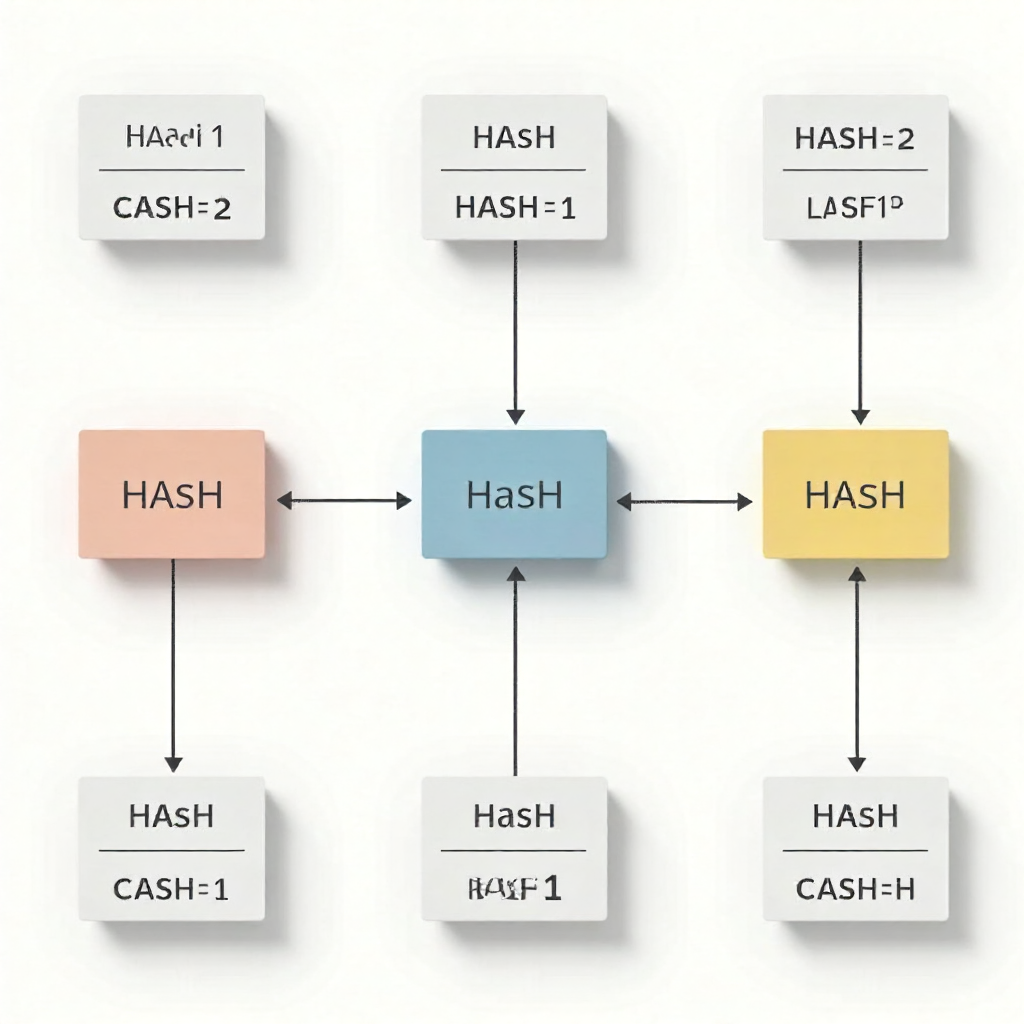
Key Components: Nodes, Blocks, and Cryptographic Hashes
Three technical elements make a blockchain function: nodes, blocks, and cryptographic hashes. Understanding each one separately makes the whole system click into place.
Nodes
A node is any computer that participates in the blockchain network. Some nodes store the full history of every transaction ever recorded (full nodes). Others handle only recent data. When a new transaction occurs, it broadcasts to all nodes, which validate it independently before it gets added to the ledger.
The distributed nature of nodes is what makes blockchain resilient. There's no headquarters to shut down. As long as even a fraction of nodes remain active, the network continues operating.
Blocks
Each block is essentially a container. It holds a set of validated transactions, a timestamp, and metadata. Once a block reaches its capacity, it closes and a new one begins. The closed block gets added to the chain — permanently.
Cryptographic Hashes
A cryptographic hash is a fixed-length string of characters generated from input data using a mathematical algorithm. Feed the same data in, and you always get the same hash out. Change even one character of the input, and the hash changes completely.
Every block contains the hash of the previous block. This is the mechanism that makes the chain tamper-evident. Altering historical data would require recalculating the hash for every subsequent block — an astronomically expensive task on a large network.
How Consensus Mechanisms Keep the Network in Agreement
A consensus mechanism is the set of rules a blockchain network uses to agree on which transactions are valid and in what order they occurred. Without consensus, participants with conflicting versions of the ledger would have no way to resolve disagreements.
Two dominant models handle this today:
- Proof of Work (PoW): Nodes (called miners) compete to solve complex mathematical puzzles. The winner adds the next block and receives a reward. The computational effort required makes fraud extremely expensive — an attacker would need to outpace the entire honest network. Bitcoin uses this model. The trade-off is significant energy consumption.
- Proof of Stake (PoS): Validators are chosen based on the amount of cryptocurrency they "stake" as collateral. Dishonest behavior risks losing that stake. This approach uses far less energy than Proof of Work, which is why many newer networks — and Ethereum after its 2022 transition — adopted it. The trade-off is that larger stakeholders gain proportionally more influence over validation.
Both mechanisms solve the same core problem: how do strangers who don't trust each other reach agreement on shared data? The answer, in each case, is to make dishonesty costly.
Why Immutability and Decentralization Matter
Immutability means that once data is recorded on a blockchain, it cannot be altered or deleted without detection. Decentralization means no single entity controls the network. Together, these properties create something genuinely new: a system where trust is built into the architecture rather than delegated to an institution.
For practical purposes, this matters in several ways. Records of ownership, contracts, or transactions become verifiable by anyone without requiring a trusted intermediary. Audits that once took weeks can be performed in real time. Fraud that relies on altering records becomes structurally much harder to execute.
There are honest trade-offs here. Immutability means mistakes are also permanent — a wrongly recorded transaction can't simply be deleted. Decentralization can slow decision-making, since changes to the network require broad consensus. These aren't reasons to dismiss the technology, but they're worth understanding before assuming blockchain solves every record-keeping problem.
Blockchain and Digital Assets: The Practical Connection
Digital assets — cryptocurrencies, tokens, and non-fungible tokens — exist because of blockchain. The ledger is what proves ownership. When you hold a digital asset, what you actually hold is a cryptographically verified entry on a distributed ledger stating that a particular address controls a particular amount.
This is where smart contracts become relevant. A smart contract is a self-executing program stored on a blockchain that automatically carries out predefined actions when specific conditions are met. No intermediary needed. If Party A sends payment, the contract automatically transfers the asset to Party A — with no human required to process the exchange.
Smart contracts power decentralized finance applications, token issuance, and automated governance systems. They're also where the distinction between different blockchains becomes practically important. Ethereum was designed with smart contract functionality at its core. Bitcoin's design prioritizes simplicity and security over programmability. Different blockchains make different trade-offs, and different digital assets are built on different underlying networks as a result.
Common Misconceptions About Blockchain
A few persistent misunderstandings make blockchain harder to evaluate clearly. Here are the ones worth correcting:
"Blockchain equals Bitcoin." Bitcoin is one application built on one blockchain. The underlying technology is far broader and is being applied in supply chain management, healthcare records, voting systems, and more.
"Blockchain transactions are completely anonymous." Most public blockchains are pseudonymous, not anonymous. Transactions are linked to wallet addresses, not names — but those addresses are publicly visible on the ledger. With enough analysis, transactions can often be traced back to real identities. Privacy-focused blockchains exist specifically to address this, using additional cryptographic techniques to obscure transaction details.
"Blockchain data is 100% secure from all threats." The data structure is highly tamper-resistant, but the ecosystem around it — wallets, exchanges, user behavior — introduces vulnerabilities. Most high-profile losses in the digital asset space have involved compromised private keys or exchange failures, not attacks on the blockchain itself.
"All blockchains are public." Private and permissioned blockchains exist where access is restricted to approved participants. Enterprises often prefer these for internal use cases where full public transparency isn't desirable. You can learn more about the technical foundations of cryptographic systems through resources like the NIST Computer Security Resource Center.
Frequently Asked Questions
What is the difference between blockchain and a regular database?
A traditional database is controlled by a central authority that can modify or delete records. A blockchain distributes identical copies across many nodes, and changes require network-wide consensus — making unauthorized alterations detectable and extremely difficult to execute.
Is all blockchain data public?
Not necessarily. Public blockchains like Bitcoin's are fully transparent — anyone can view the transaction history. Private and permissioned blockchains restrict access to approved participants. Even on public chains, data is pseudonymous rather than directly tied to real-world identities.
Can blockchain data ever be changed or deleted?
In practice, no — not without the consensus of the network and not without it being detectable. The cryptographic hash structure means altering any historical block invalidates every block that follows it. Some networks have implemented governance mechanisms to handle exceptional situations, but these are rare and require broad community agreement.
What is a smart contract and how does it relate to blockchain?
A smart contract is a self-executing program stored on a blockchain. It runs automatically when predefined conditions are met, without requiring a human intermediary. Smart contracts are what make blockchains programmable — enabling digital assets, decentralized applications, and automated financial agreements.
Do all digital assets use the same type of blockchain?
No. Different digital assets are built on different blockchains, each with its own consensus mechanism, programming capabilities, and design priorities. Bitcoin operates on its own network. Many tokens are built on Ethereum or other smart contract platforms. Each blockchain involves different technical trade-offs in speed, security, and functionality.